 Add to Chrome
 Add to Firefox
 Add to Edge
MRT: Masked Region Transformer for Layered Image Generation and Editing at Scale
May 26, 2026
Layered image generation and editing is a fundamental capability that enables layer-wise reuse, editing, and composition of generated visual content, analogous to word-level editing in natural language. Despite its importance, this remains an underexplored area at scale. To address this gap, we present MRT, a 20B-parameter masked region diffusion model tailored for multi-layer transparent image generation and editing, trained on over 10M multilingual design samples spanning diverse aspect ratios and textual prompts. To fully leverage this scale, we make two key technical contributions. First, we unify three complementary tasks including text-to-layers, image-to-layers, and layers-to-layers within a shared masked region diffusion framework, where selective token masking enables flexible layer-wise generation and editing. Second, to enable overflow layer generation, we introduce an overflow-aware canvas layer that handles boundary inconsistencies and supports semi-transparent background synthesis, enabling complete editable layers extending beyond visible canvas boundaries. Additionally, we apply diffusion distillation to achieve 8-step, real-time multi-layer generation with minimal quality degradation. Extensive experiments demonstrate that our framework substantially outperforms prior state-of-the-art approaches, including various commercial systems, across all three tasks, establishing a new benchmark for multi-layer transparent image generation. Notably, our model significantly outperforms the concurrent Qwen-Image-Layered model in image-to-layers quality according to user-study results, while achieving 10-100\times faster inference and reducing activation GPU memory consumption by 50-90\% during image-to-layer inference.

Pareto-Guided Optimal Transport for Multi-Reward Alignment
May 13, 2026Text-to-image generation models have achieved remarkable progress in preference optimization, yet achieving robust alignment across diverse reward models remains a significant challenge. Existing multi-reward fusion approaches rely on weighted summation, which is costly to tune and insufficient for balancing conflicting objectives. More critically, optimization with reward models is highly susceptible to reward hacking, where reward scores increase while the perceived quality of generated images deteriorates. We demonstrate that optimizing against a unified global target under heterogeneous reward upper bounds can induce reward hacking, a risk further exacerbated by the inherent instability of weak reward models. To mitigate this, we propose a Pareto Frontier-Guided Optimal Transport (PG-OT) framework. Our method constructs a prompt-specific Pareto frontier and maps dominated samples toward it via distribution-aware optimal transport. Furthermore, we develop both online and offline optimization strategies tailored to diverse reward signal characteristics. To provide a more rigorous assessment, we introduce the Joint Domination Rate (JDR) and Joint Collapse Rate (JCR) as principled metrics to quantify multi-reward synergy and reward hacking. Experimental results show that our approach outperforms strong baselines with an 11% gain in JDR and achieves a near 80% win rate in human evaluations.
Premier: Personalized Preference Modulation with Learnable User Embedding in Text-to-Image Generation
Mar 21, 2026Text-to-image generation has advanced rapidly, yet it still struggles to capture the nuanced user preferences. Existing approaches typically rely on multimodal large language models to infer user preferences, but the derived prompts or latent codes rarely reflect them faithfully, leading to suboptimal personalization. We present Premier, a novel preference modulation framework for personalized image generation. Premier represents each user's preference as a learnable embedding and introduces a preference adapter that fuses the user embedding with the text prompt. To enable accurate and fine-grained preference control, the fused preference embedding is further used to modulate the generative process. To enhance the distinctness of individual preference and improve alignment between outputs and user-specific styles, we incorporate a dispersion loss that enforces separation among user embeddings. When user data are scarce, new users are represented as linear combinations of existing preference embeddings learned during training, enabling effective generalization. Experiments show that Premier outperforms prior methods under the same history length, achieving stronger preference alignment and superior performance on text consistency, ViPer proxy metrics, and expert evaluations.
Learning User Preferences for Image Generation Model
Aug 11, 2025User preference prediction requires a comprehensive and accurate understanding of individual tastes. This includes both surface-level attributes, such as color and style, and deeper content-related aspects, such as themes and composition. However, existing methods typically rely on general human preferences or assume static user profiles, often neglecting individual variability and the dynamic, multifaceted nature of personal taste. To address these limitations, we propose an approach built upon Multimodal Large Language Models, introducing contrastive preference loss and preference tokens to learn personalized user preferences from historical interactions. The contrastive preference loss is designed to effectively distinguish between user ''likes'' and ''dislikes'', while the learnable preference tokens capture shared interest representations among existing users, enabling the model to activate group-specific preferences and enhance consistency across similar users. Extensive experiments demonstrate our model outperforms other methods in preference prediction accuracy, effectively identifying users with similar aesthetic inclinations and providing more precise guidance for generating images that align with individual tastes. The project page is \texttt{https://learn-user-pref.github.io/}.
V2Flow: Unifying Visual Tokenization and Large Language Model Vocabularies for Autoregressive Image Generation
Mar 10, 2025We propose V2Flow, a novel tokenizer that produces discrete visual tokens capable of high-fidelity reconstruction, while ensuring structural and latent distribution alignment with the vocabulary space of large language models (LLMs). Leveraging this tight visual-vocabulary coupling, V2Flow enables autoregressive visual generation on top of existing LLMs. Our approach formulates visual tokenization as a flow-matching problem, aiming to learn a mapping from a standard normal prior to the continuous image distribution, conditioned on token sequences embedded within the LLMs vocabulary space. The effectiveness of V2Flow stems from two core designs. First, we propose a Visual Vocabulary resampler, which compresses visual data into compact token sequences, with each represented as a soft categorical distribution over LLM's vocabulary. This allows seamless integration of visual tokens into existing LLMs for autoregressive visual generation. Second, we present a masked autoregressive Rectified-Flow decoder, employing a masked transformer encoder-decoder to refine visual tokens into contextually enriched embeddings. These embeddings then condition a dedicated velocity field for precise reconstruction. Additionally, an autoregressive rectified-flow sampling strategy is incorporated, ensuring flexible sequence lengths while preserving competitive reconstruction quality. Extensive experiments show that V2Flow outperforms mainstream VQ-based tokenizers and facilitates autoregressive visual generation on top of existing. https://github.com/zhangguiwei610/V2Flow
Uniform Attention Maps: Boosting Image Fidelity in Reconstruction and Editing
Nov 29, 2024


Text-guided image generation and editing using diffusion models have achieved remarkable advancements. Among these, tuning-free methods have gained attention for their ability to perform edits without extensive model adjustments, offering simplicity and efficiency. However, existing tuning-free approaches often struggle with balancing fidelity and editing precision. Reconstruction errors in DDIM Inversion are partly attributed to the cross-attention mechanism in U-Net, which introduces misalignments during the inversion and reconstruction process. To address this, we analyze reconstruction from a structural perspective and propose a novel approach that replaces traditional cross-attention with uniform attention maps, significantly enhancing image reconstruction fidelity. Our method effectively minimizes distortions caused by varying text conditions during noise prediction. To complement this improvement, we introduce an adaptive mask-guided editing technique that integrates seamlessly with our reconstruction approach, ensuring consistency and accuracy in editing tasks. Experimental results demonstrate that our approach not only excels in achieving high-fidelity image reconstruction but also performs robustly in real image composition and editing scenarios. This study underscores the potential of uniform attention maps to enhance the fidelity and versatility of diffusion-based image processing methods. Code is available at https://github.com/Mowenyii/Uniform-Attention-Maps.
STAR: Scale-wise Text-to-image generation via Auto-Regressive representations
Jun 16, 2024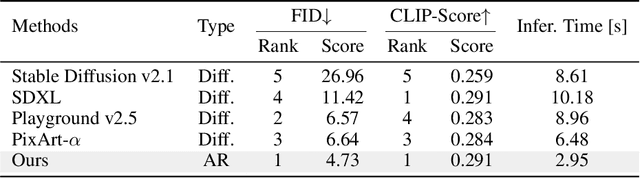
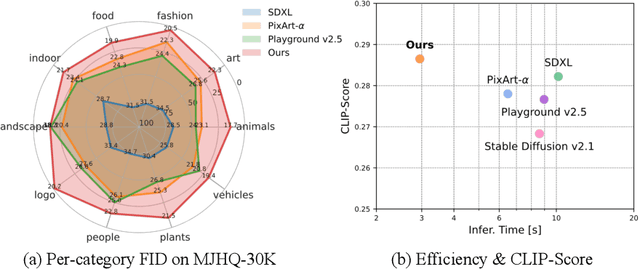
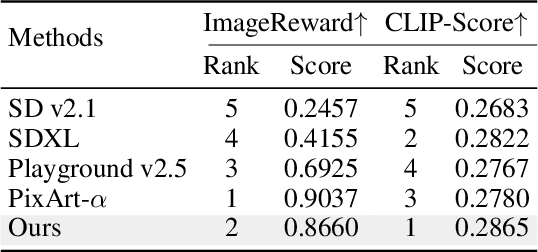
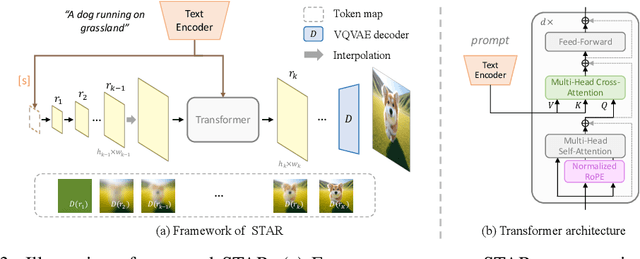
We present STAR, a text-to-image model that employs scale-wise auto-regressive paradigm. Unlike VAR, which is limited to class-conditioned synthesis within a fixed set of predetermined categories, our STAR enables text-driven open-set generation through three key designs: To boost diversity and generalizability with unseen combinations of objects and concepts, we introduce a pre-trained text encoder to extract representations for textual constraints, which we then use as guidance. To improve the interactions between generated images and fine-grained textual guidance, making results more controllable, additional cross-attention layers are incorporated at each scale. Given the natural structure correlation across different scales, we leverage 2D Rotary Positional Encoding (RoPE) and tweak it into a normalized version. This ensures consistent interpretation of relative positions across token maps at different scales and stabilizes the training process. Extensive experiments demonstrate that STAR surpasses existing benchmarks in terms of fidelity,image text consistency, and aesthetic quality. Our findings emphasize the potential of auto-regressive methods in the field of high-quality image synthesis, offering promising new directions for the T2I field currently dominated by diffusion methods.
Dynamic Prompt Optimizing for Text-to-Image Generation
Apr 05, 2024
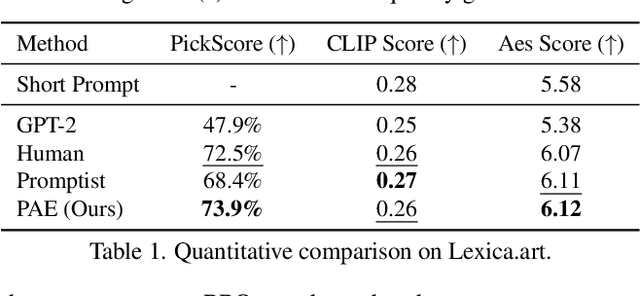

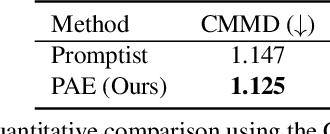
Text-to-image generative models, specifically those based on diffusion models like Imagen and Stable Diffusion, have made substantial advancements. Recently, there has been a surge of interest in the delicate refinement of text prompts. Users assign weights or alter the injection time steps of certain words in the text prompts to improve the quality of generated images. However, the success of fine-control prompts depends on the accuracy of the text prompts and the careful selection of weights and time steps, which requires significant manual intervention. To address this, we introduce the \textbf{P}rompt \textbf{A}uto-\textbf{E}diting (PAE) method. Besides refining the original prompts for image generation, we further employ an online reinforcement learning strategy to explore the weights and injection time steps of each word, leading to the dynamic fine-control prompts. The reward function during training encourages the model to consider aesthetic score, semantic consistency, and user preferences. Experimental results demonstrate that our proposed method effectively improves the original prompts, generating visually more appealing images while maintaining semantic alignment. Code is available at https://github.com/Mowenyii/PAE.
StyleInject: Parameter Efficient Tuning of Text-to-Image Diffusion Models
Jan 25, 2024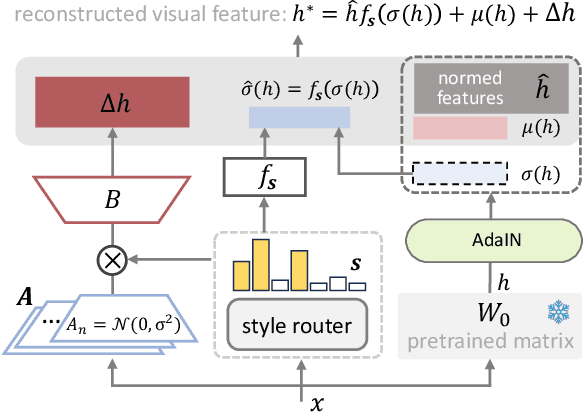
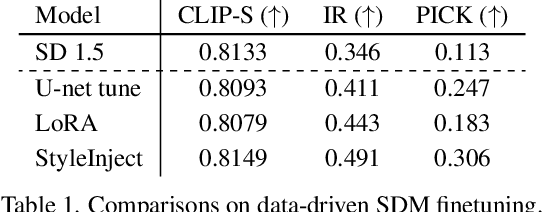
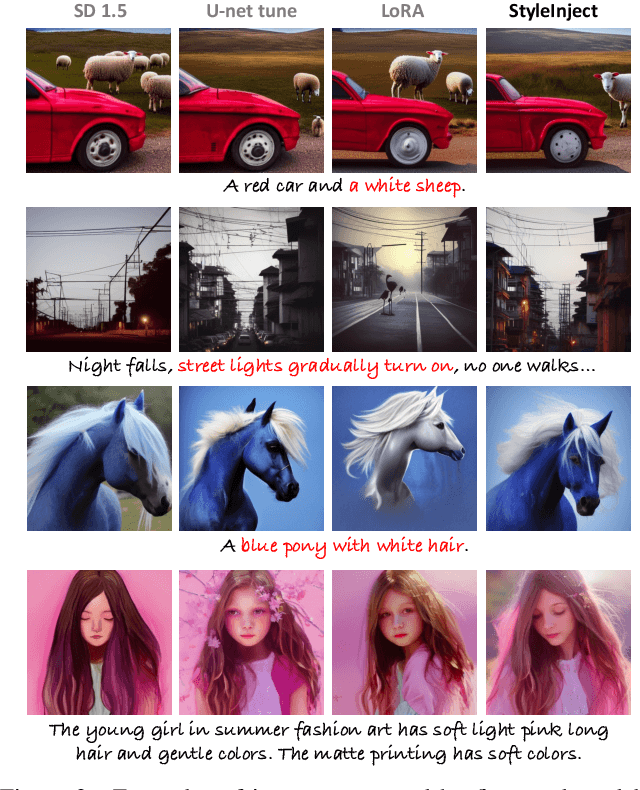
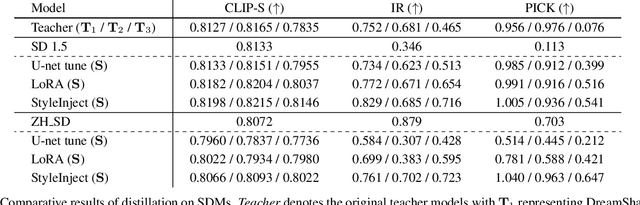
The ability to fine-tune generative models for text-to-image generation tasks is crucial, particularly facing the complexity involved in accurately interpreting and visualizing textual inputs. While LoRA is efficient for language model adaptation, it often falls short in text-to-image tasks due to the intricate demands of image generation, such as accommodating a broad spectrum of styles and nuances. To bridge this gap, we introduce StyleInject, a specialized fine-tuning approach tailored for text-to-image models. StyleInject comprises multiple parallel low-rank parameter matrices, maintaining the diversity of visual features. It dynamically adapts to varying styles by adjusting the variance of visual features based on the characteristics of the input signal. This approach significantly minimizes the impact on the original model's text-image alignment capabilities while adeptly adapting to various styles in transfer learning. StyleInject proves particularly effective in learning from and enhancing a range of advanced, community-fine-tuned generative models. Our comprehensive experiments, including both small-sample and large-scale data fine-tuning as well as base model distillation, show that StyleInject surpasses traditional LoRA in both text-image semantic consistency and human preference evaluation, all while ensuring greater parameter efficiency.
Learning and Evaluating Human Preferences for Conversational Head Generation
Aug 02, 2023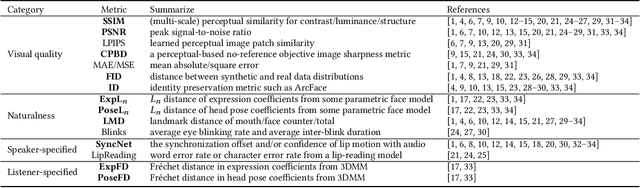
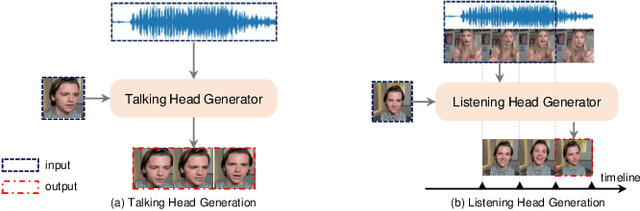
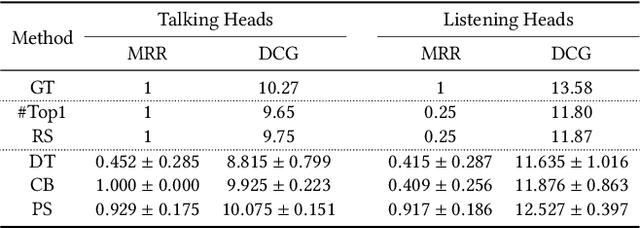
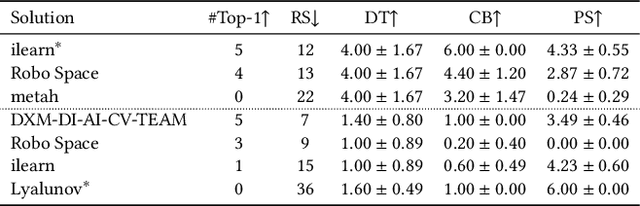
A reliable and comprehensive evaluation metric that aligns with manual preference assessments is crucial for conversational head video synthesis methods development. Existing quantitative evaluations often fail to capture the full complexity of human preference, as they only consider limited evaluation dimensions. Qualitative evaluations and user studies offer a solution but are time-consuming and labor-intensive. This limitation hinders the advancement of conversational head generation algorithms and systems. In this paper, we propose a novel learning-based evaluation metric named Preference Score (PS) for fitting human preference according to the quantitative evaluations across different dimensions. PS can serve as a quantitative evaluation without the need for human annotation. Experimental results validate the superiority of Preference Score in aligning with human perception, and also demonstrate robustness and generalizability to unseen data, making it a valuable tool for advancing conversation head generation. We expect this metric could facilitate new advances in conversational head generation. Project Page: https://https://github.com/dc3ea9f/PreferenceScore.